


Beyond The Price Tag
Why the Scanning Fiber Endoscope is a Strategic Financial Investment for the Cath Lab
Juan Vegarra
Add paragraph text. Click “Edit Text” to update the font, size and more. To change and reuse text themes, go to Site Styles.
In the demanding world of a modern Cath Lab, every decision, from the choice of a guidewire to the latest imaging system, is scrutinized through a dual lens: clinical efficacy and financial viability. While the primary mission remains unparalleled patient care, the economic realities of healthcare systems mean that new technologies, no matter how clinically superior, must present a compelling argument for their adoption. They must not only offer better outcomes but also demonstrate a tangible return on investment, aligning with the relentless pressure to optimize resources and reduce costs.


For years, the gold standard in intravascular imaging, like much of endoscopy, has relied on established technologies that, while effective, come with inherent limitations – both clinical and financial. But a new era of intra-luminal diagnostics is dawning with the Scanning Fiber Endoscope (SFE).
At first glance, the SFE might appear to be a premium investment, a cutting-edge piece of equipment carrying a higher upfront cost than conventional tools. However, a deeper dive into its capabilities and operational impact reveals that the SFE isn't just a clinical advancement; it's a strategic financial investment that promises to revolutionize the Cath Lab's economic model, saving significant time, money, and ultimately, lives.
This blog will dissect the financial justification for integrating the SFE into the Cath Lab, moving beyond the initial price tag to illuminate its profound long-term economic benefits and operational efficiencies. We will explore how this multi-modal platform can become a cornerstone of both clinical excellence and fiscal responsibility.
The Cath Lab's Economic Tightrope: Balancing Care and Cost
The Cath Lab is a high-stakes, high-cost environment. It's where critical interventions for heart attacks, strokes, and peripheral artery disease are performed, often in emergency situations. Equipment is expensive, staffing is specialized, and procedures are complex. Directors of Cath Labs and hospital administrators constantly walk a tightrope, balancing the imperative to provide the best possible patient care with the formidable pressure to manage budgets, reduce waste, and improve efficiency.
Traditional intravascular imaging techniques, such as conventional angiography, intravascular ultrasound (IVUS), and even some forms of optical coherence tomography (OCT) as separate devices, each contribute to the diagnostic pathway. However, they often come with their own set of inefficiencies and hidden costs:
● Sequential Diagnostics: Often requiring multiple passes with different devices, prolonging procedure time.
● Limited Information: Providing only a partial picture, potentially leading to suboptimal treatment decisions or the need for follow-up procedures.
● Reprocessing Costs: For reusable devices, sterilization adds significant overhead in terms of time, labor, and expensive chemicals.
● Inventory Management: Maintaining multiple, specialized devices and their consumables.
Into this complex economic landscape steps the SFE, not as another incremental cost, but as a potential solution to many of these entrenched financial challenges.
Unpacking the SFE's Financial Value Proposition: Beyond Acquisition Cost
The most crucial step in justifying the SFE is to look beyond its unit acquisition cost and analyze its total economic impact across the entire patient care continuum. Its value proposition is built on several pillars:

1. Reduced Procedure Time and Improved Throughput
Time is money in the Cath Lab. Every minute a patient is on the table, resources are consumed – staff salaries, operating room overhead, equipment depreciation, and patient billing time. The SFE's inherent multi-modal capability directly addresses this:
● Integrated Diagnostics: Instead of switching between separate white light endoscopes, IVUS catheters, or different OCT probes, the SFE can perform all these functions (white light, fluorescence, OCT, and potentially Raman spectroscopy) with a single pass of a single, ultra-thin fiber. This dramatically reduces the time spent on device exchange, re-positioning, and recalibration.
● Faster Decision-Making: Real-time, comprehensive data from multiple modalities allows interventionalists to make quicker, more confident decisions regarding lesion characterization, plaque stability, and optimal intervention strategies (e.g., stent sizing, lesion preparation). This minimizes diagnostic "dead time" during a procedure.
● Increased Lab Efficiency: Shorter procedure times mean the Cath Lab can schedule more cases per day, increasing patient throughput and maximizing the utilization of expensive capital equipment and highly trained staff. Even a reduction of 15-20 minutes per complex case, when aggregated across hundreds of procedures annually, translates into substantial operational savings and increased revenue potential.
Quantifiable Impact:
If a Cath Lab performs 1,000 complex intravascular procedures per year, and the SFE saves an average of 15 minutes per case, that's 250 hours of saved Cath Lab time. At an estimated hourly cost of $1,000-$2,000 for a fully staffed and equipped Cath Lab (including staff salaries, overhead, and capital depreciation), this equates to a potential saving of $250,000 to $500,000 annually in direct operational costs.
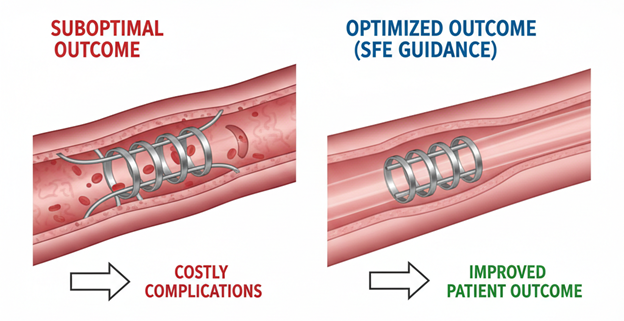
2. Optimized Treatment Decisions and Reduced Complications
Suboptimal treatment decisions, often stemming from incomplete diagnostic information, are a major source of avoidable costs in interventional cardiology. These include:
● Stent Malapposition/Underexpansion: If a stent is not optimally deployed (e.g., wrong size, insufficient expansion), it can lead to complications like in-stent restenosis or thrombosis, requiring costly repeat procedures. The SFE's high-resolution OCT can precisely guide stent deployment, ensuring optimal results on the first attempt.
● Unnecessary Procedures: With clearer, real-time lesion characterization (e.g., differentiating stable plaque from vulnerable plaque), the SFE can help avoid unnecessary interventions, saving resources and reducing patient risk.
● Reduced Complication Rates: More precise diagnosis and treatment lead to fewer complications (e.g., dissection, perforation, no-reflow phenomena). Each complication not only harms the patient but incurs significant additional costs in terms of extended hospital stays, additional medications, and further interventions.
Quantifiable Impact:
A single major adverse cardiac event (MACE) can add tens of thousands of dollars to a patient's care cost. If the SFE can reduce the MACE rate by even 1-2% due to superior guidance and decision-making, it represents significant savings. For 1,000 procedures, a 1% reduction in MACE could prevent 10 costly complications, potentially saving $100,000 to $500,000+ annually depending on the severity of prevented events.
3. Elimination of Reprocessing Costs and Enhanced Infection Control
This is a major, often underestimated, financial advantage for SFE designs that are single-use and disposable.
● Direct Cost Savings: Reprocessing reusable endoscopes is a costly, multi-step process involving highly specialized equipment (automated endoscope reprocessors), expensive detergents, disinfectants, and significant labor. A single reprocessing cycle can cost $50-$150. Eliminating this completely represents a direct and substantial saving.
● Reduced Capital Expenditure: Eliminates the need to purchase and maintain expensive reprocessing equipment.
● Lower Risk of Infection-Related Costs: Despite stringent protocols, there is always a residual risk of healthcare-associated infections (HAIs) from reprocessed devices. Each HAI incurs massive costs, both financial (extended hospital stays, antibiotics, litigation) and human (patient suffering, mortality). Disposable SFEs completely negate this risk, offering unparalleled infection control and avoiding potentially catastrophic financial penalties.
● Eliminated Repair Costs: Reusable scopes are prone to damage during procedures or reprocessing, leading to frequent and expensive repairs that can cost thousands of dollars per incident and take devices out of commission. Disposable SFEs eliminate this entire cost category.
Quantifiable Impact:
If a Cath Lab performs 1,000 procedures with reusable endoscopes, and reprocessing costs $100 per cycle, simply eliminating reprocessing saves $100,000 annually. Add to that averted repair costs (potentially tens of thousands) and the prevention of even one or two costly HAIs (which can run into hundreds of thousands), and the savings become immense.
4. Revenue Generation and Enhanced Competitive Edge
The SFE isn't just about saving costs; it's also about creating opportunities for revenue generation and strengthening the Cath Lab's market position:
● Attracting Referrals: Offering cutting-edge, multi-modal diagnostic capabilities positions the Cath Lab as a leader in cardiovascular care. This can attract more referrals from local physicians and patients seeking the most advanced treatments.
● Enhanced Research Opportunities: The SFE's advanced data collection capabilities can facilitate participation in clinical trials and research, generating additional revenue streams and enhancing the institution's academic reputation.
● Earlier Intervention and Broader Patient Pool: The ability of the SFE to reach previously inaccessible areas or diagnose conditions earlier (e.g., very peripheral lung lesions, small vessel disease) could expand the range of treatable patients and the types of procedures that can be performed, potentially increasing overall patient volume for the institution.
Strategic Implementation: Making the Business Case
To successfully integrate the SFE, Cath Lab directors and hospital leadership need a clear, data-driven business case that addresses both the initial investment and the long-term ROI.
Pilot Program with Data Collection: Start with a pilot program in specific high-volume or complex procedure areas where the SFE's benefits are most pronounced. Rigorously collect data on procedure time, complication rates, need for repeat procedures, and reprocessing costs (if applicable, for comparison with reusable devices).
Cost-Benefit Analysis (CBA) & Return on Investment (ROI): Develop a comprehensive CBA that quantifies the savings and revenue generation potential against the acquisition cost over a 3-5 year period. Calculate a clear ROI to present to hospital administration.
Physician and Staff Buy-in: Demonstrate the SFE's clinical advantages to interventionalists and support staff. Their enthusiasm and adoption are crucial for realizing efficiency gains. Highlight how it makes their job easier, faster, and more effective.
Reimbursement Strategy: Ensure a robust reimbursement strategy is in place for the SFE and associated procedures. Work with billing and coding departments to maximize appropriate reimbursement.
The SFE as a Future-Proof Investment
Investing in the SFE is not merely purchasing a new piece of equipment; it's investing in the future of the Cath Lab. It positions the institution at the forefront of medical technology, enabling:
● Improved Patient Outcomes: Which is, and always will be, the ultimate goal, and often leads to indirect financial benefits through higher patient satisfaction and reputation.
● Enhanced Operational Efficiency: Streamlining workflows and maximizing resource utilization.
● Risk Mitigation: Reducing complications, infections, and associated financial liabilities.
● Sustainable Growth: Attracting talent, patients, and research opportunities that drive long-term institutional success.
The initial sticker shock of advanced technologies can often overshadow their profound downstream benefits. For the Scanning Fiber Endoscope in the Cath Lab, the financial argument is compelling and multi-layered. It's an investment that moves beyond simply doing things better, to fundamentally reshaping how diagnostics and interventions are performed – saving time, saving money, and most importantly, saving lives in a smarter, more economically responsible way. The SFE is not just an expense; it is a meticulously calculated strategic asset for the financially astute Cath Lab.
FAQs about SFE in the Cath Lab (Financial Perspective)
1. Is the SFE a significant upfront investment for a Cath Lab?
Yes, advanced technologies like the SFE typically have a higher initial acquisition cost compared to conventional devices.
2. How does the SFE save money in the Cath Lab?
It saves money by reducing procedure time, optimizing treatment decisions (fewer complications, fewer repeat procedures), eliminating reprocessing costs (for disposable models), and potentially increasing patient throughput.
3. What is the impact of reduced procedure time?
Shorter procedure times free up valuable Cath Lab resources (staff, room usage), allowing more procedures to be scheduled and reducing overall operational costs per case.
4. How does multi-modal imaging help financially?
By providing comprehensive, real-time data, multi-modal imaging leads to more accurate and efficient decision-making, reducing diagnostic delays and the costs associated with suboptimal treatments or complications.
5. Does using disposable SFE eliminate costs?
For disposable SFE models, yes. It eliminates the direct costs of reprocessing (labor, chemicals, equipment maintenance) and significantly reduces the risks and associated costs of healthcare-associated infections and device repairs.
Sources
The information on the financial benefits of the SFE in the Cath Lab is based on the following industry and academic sources:
1. Reduced Procedure Time and Cost Savings:
● The Society for Cardiovascular Angiography and Interventions (SCAI): Provides data on Cath Lab efficiency and the economic impact of procedure time.
○ Link: https://www.scai.org/
2. The Cost of Complications and Treatment Optimization:
● Journal of the American College of Cardiology (JACC): This journal and its sister publications frequently publish studies on the cost of cardiovascular complications, such as stent failure and MACE (Major Adverse Cardiac Events).
○ Link: https://www.jacc.org/
3. Elimination of Reprocessing Costs and Infection Risk:
● Centers for Disease Control and Prevention (CDC): Provides data on the prevalence and cost of healthcare-associated infections (HAIs), which are mitigated by single-use devices.
○ Link: https://www.cdc.gov/hai/surveillance/index.html
● Gastrointestinal Endoscopy Journal: Publishes research on the direct and indirect costs associated with reprocessing reusable endoscopes.
○ Link: https://www.giejournal.org/